


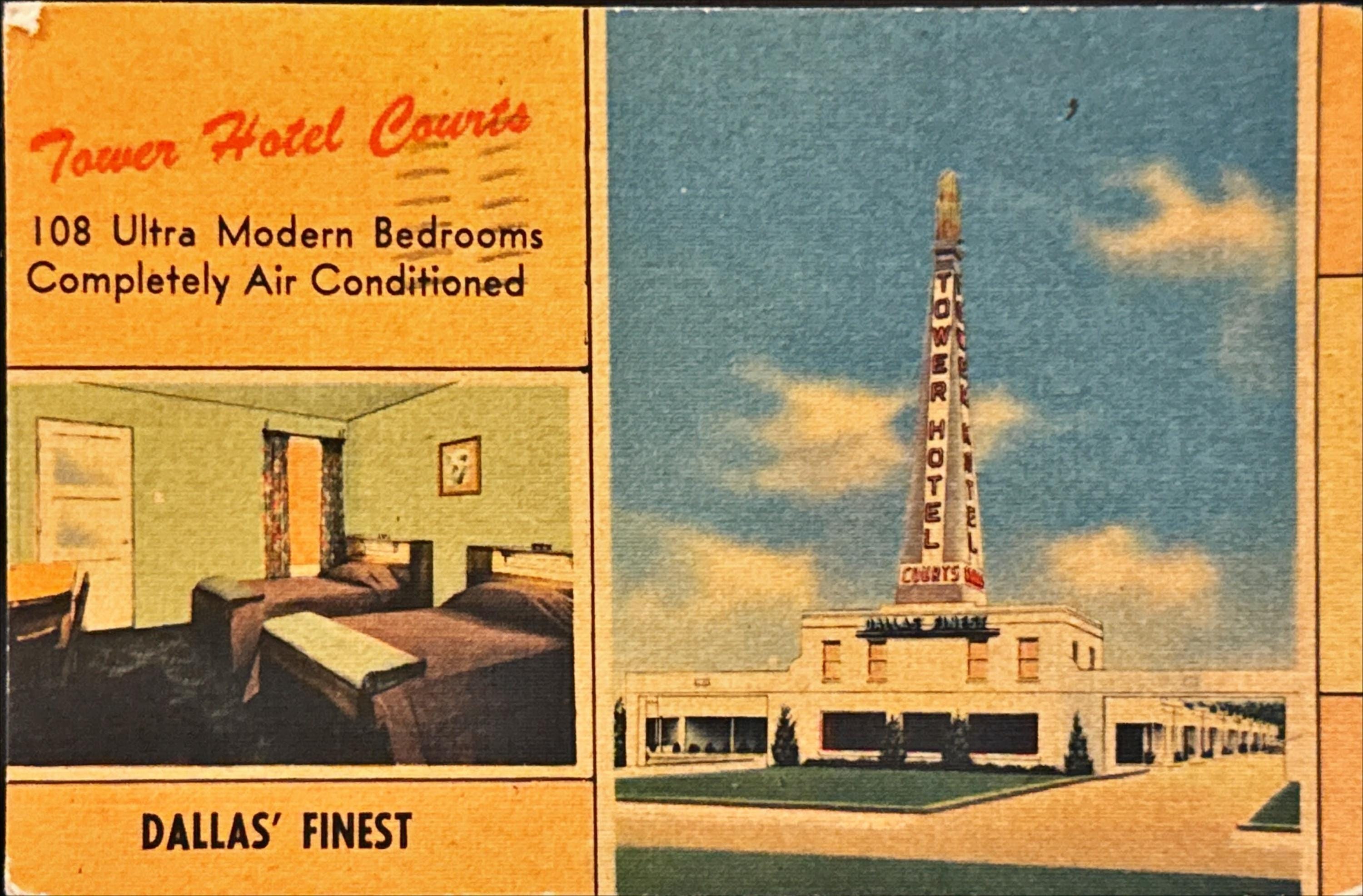
On a Friday in late August of 1947, Mildred sat at the Tower Hotel Courts and wrote a postcard home. She mentioned something that would surprise anyone who has lived through a Dallas summer.
“It is only 89 here, but I was never more uncomfortable. I prefer Oklahoma dry heat.”
That single line captures the feel of a Dallas August before air conditioning was common. Eighty-nine degrees sounds gentle for late summer, but the humidity was the real force at work. Dallas in the 1940s still had wide open fields, creeks that held moisture, and long stretches of unpaved ground. After a rain, the air could turn heavy and still. Without the wind channels created by later freeways, the heat simply settled over the landscape. Even a mild day could feel like a steam bath.
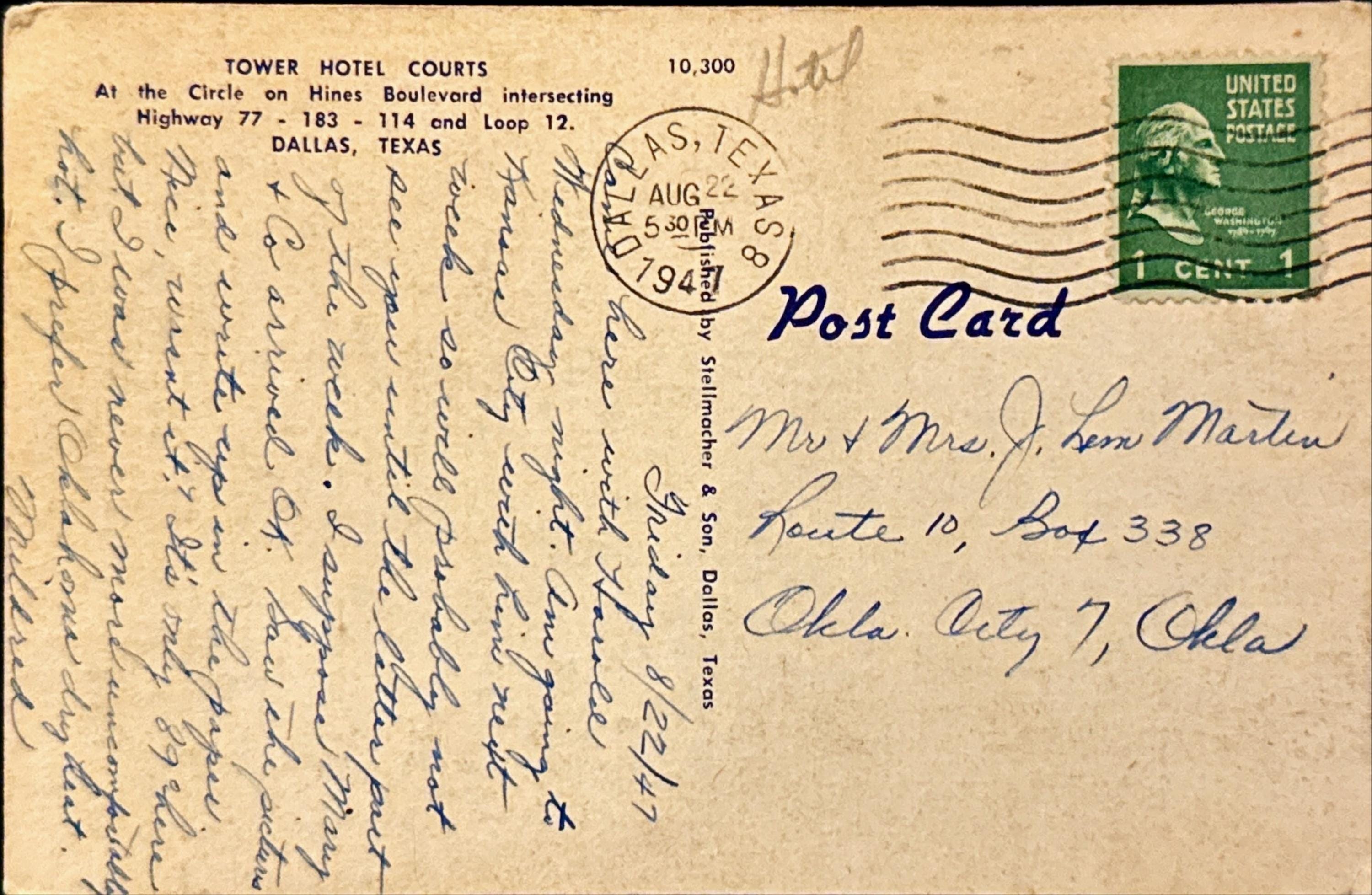
Mildred was right. Oklahoma heat was hotter, but it was also drier. Dallas humidity made a modest temperature feel like something entirely different. Yet today most Dallasites would think an 89-degree day in late August to be most splendid! Especially after 109 degrees just 13-days earlier.
The Many Names of Harry Hines Road
The postcard places the Tower Hotel Courts at a crossroads that carried several identities over time.
“At the Circle on Hines Boulevard intersecting Highway 77, 183, 114 and Loop 12.”
That single sentence is a snapshot of Dallas’ road history.
Hi Line Road
Before the city renamed it, the corridor was known as Hi Line Road. It followed the railroad high line that paralleled it. Early county maps show it as a rural north south road that cut through farm tracts and the old Ware Estate.
Harry Hines Boulevard
Dallas renamed the road to honor Harry Hines, the Texas Highway Commissioner who pushed for modern road building. The name stuck, although the numbering changed more than once.
U. S. Highway 77
For decades, Harry Hines carried U. S. 77, the main north south highway through Dallas. Tourist courts, diners, and motor inns grew along it, including the Tower Hotel Courts. U. S. 77 was effectively decommissioned in Dallas in 1969, when Interstate 35E fully replaced it through the city.
But the number lingered in pieces elsewhere in Texas until the early 1990s.
State Highways 114 and 183, and Loop 12
As Dallas expanded, the intersection became a meeting point for several major routes. The postcard captures a moment when the roads were still recognizable, but the freeway era was already beginning to reshape the landscape.
As The Circle was never planned as a permanent fix, map makers overlooked it and the only reference I could find was through an odyssey of maps on TxDot’s Real Property Asset Map in their Right-of-Way files. It is an incomplete view of the almost constructed “Circle”.
The Circle That Once Defined the Intersection
The Circle mentioned on the postcard was a large rotary where Harry Hines, Loop 12, State Highway 114, and State Highway 183 all met. It was built in the early 1950s as a modern solution to growing traffic.
For a time, it worked well.
As Dallas grew, the Circle became a choke point.
By the late 1960s, the rotary was removed and replaced with the directional interchange that stands today.
By the early 1970s, when I remember seeing the giant neon sign for The Circle Inn, the Circle itself had already vanished. Its bright neon sign was standing on a rocky hill like a beacon that welcomed me home each time we passed it. I believe it was just as NW Highway descends to go under Old Denton. You know, it’s that area that likes to flood whenever we get heavy rain. It seemed huge to me, but keep in mind I was only in 2nd grade.
In my 7-year-old historian voice, I pointed out one day that there wasn’t a circle anywhere to be found. You see, I was already developing my smart-alecky tone, but my parents gave a simple-vague answer that they thought there used to be a circle there, but it was gone. The name survived long after the road feature was gone. As I recall it, there was a theatre that appeared to stand alone, and I wondered how it came to be.
Every time we would drive down Spur-482 from 183 and round that corner onto Loop 12/NW Highway I would gaze at that bright neon sign and imagine all the wonderful things that must have happened there to warrant such an amazing sign. I might have overshot on my expectations, just a tad.
The place shut down in late 2005 and by that time was in a miserable state. It was demolished the following year, but the sign was apparently purchased by DART and donated to a private collection. You see DART was building the Northwest Rail Line, which later became part of the Orange Line (get out your color wheel).
More about that some other time, as it turned out not to be the same hotel. It only took me 3 hours of research to find that out. Yay for me!
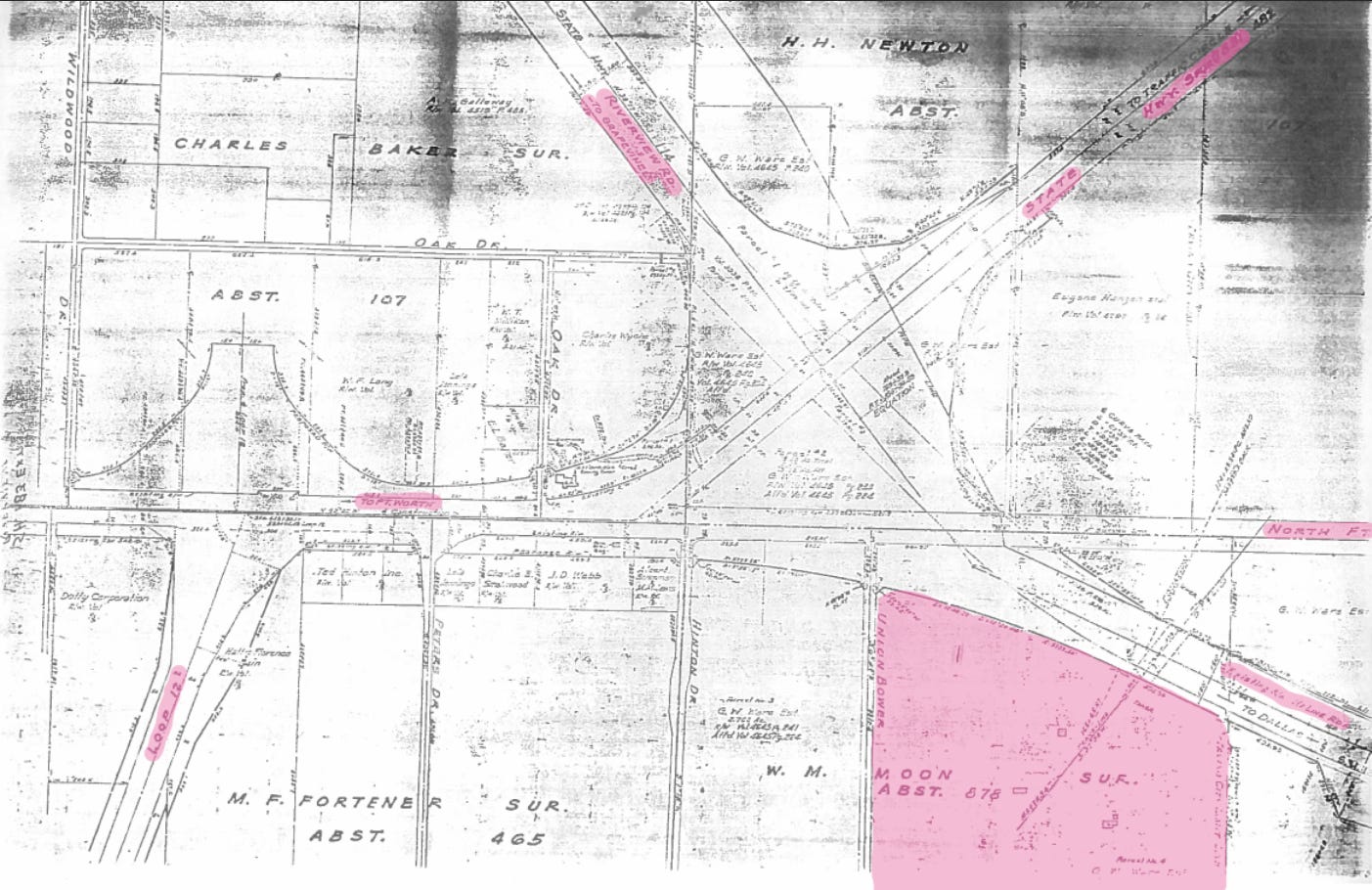
Curious readers will note that the left side of the property borders Hinton Dr. This street was standardized as Denton Drive and was influenced by the adjoining railroad corridor since it paralleled the line toward Denton County.
The Tower Hotel Courts: A Landmark That Disappeared
The Tower Hotel Courts opened around 1940 on land carved from the G. W. Ware Estate. It sat between the railroad and Harry Hines, just south of the future Circle. It was a classic motor court of its time, with rows of individual cabins, a central office, bright neon, and the promise of one hundred eight modern, air-conditioned rooms.
For travelers on U. S. 77, it was a welcome sight.
Its location, however, placed it directly in the path of Dallas highway expansion. When the state rebuilt the interchange for State Highways 114 and 183, the Tower Hotel Courts stood exactly where the new ramps needed to go. The property was acquired, the buildings were removed, and the site became part of the growing freeway system.
Today, part of the hotel’s footprint lies beneath the sweeping interchange of 114, 183, and Loop 12. Nothing remains of the hotel, but the postcard preserves a moment when the hotel was new, the Circle was a landmark, and Harry Hines was still a highway lined with tourist courts.
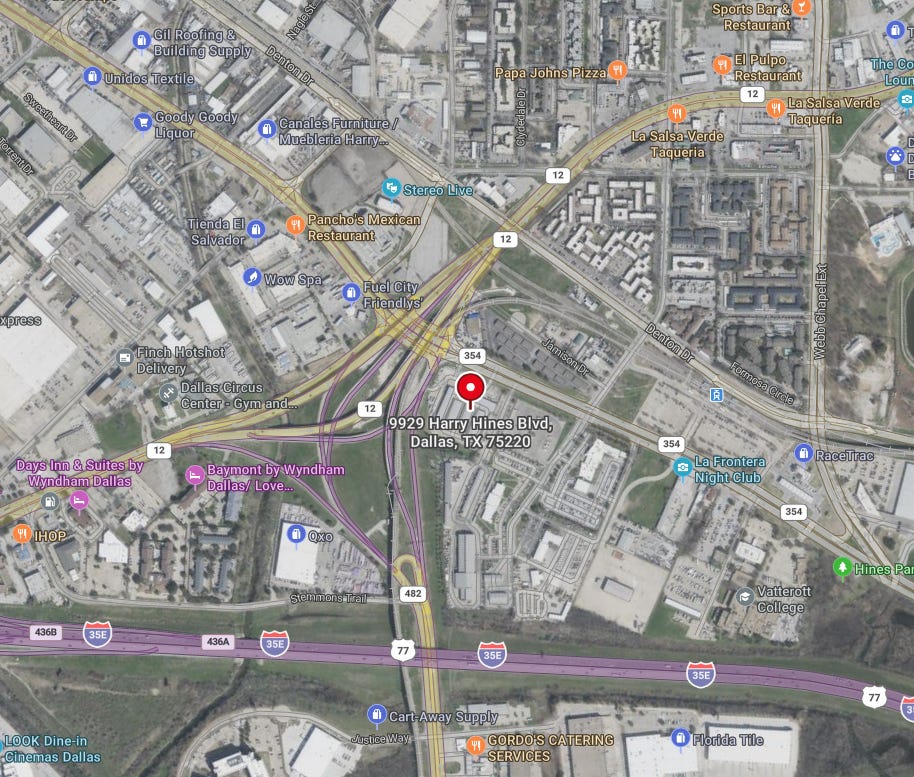
Just south of the area where NW Highway meets Spur 482 and beyond DART’s Orange line, you will find a new landmark which bears the name U-Haul at 9929 Harry Hines. It’s not a neon sign and but the place still bustles with activity.
A Postcard as a Time Machine
Mildred’s message captures a world that has vanished.
The Circle was still intact.
Harry Hines was still a major highway.
The Tower Hotel Courts was still a fresh addition to the roadside.
And Dallas was still a city of postcards, motor courts, and humid August evenings.
Who would have thought a simple postcard could reveal so much about our history? I sure didn’t!