


On the morning of May 12, 1926, at 7:00 a.m., Dallas did more than dispatch airmail. It entered a system that immediately drew national attention.
The scale of that moment was visible before the first aircraft left the ground. Contemporary reporting in the Dallas Morning News described the inaugural operation in concrete terms. Two aircraft were prepared for departure, carrying between 20,000 and 25,000 letters, a volume that signaled both public demand and institutional confidence in the new service. This was not a symbolic launch. It was a working system from its opening hour, moving tens of thousands of pieces of mail into the air at once.
Dallas had already defined how it wanted to be seen. By the early 1920s, the city promoted itself as the “City of the Hour,” a phrase grounded in immediacy rather than inheritance. It was a claim about timing. Dallas intended to matter now. When Contract Air Mail Route 3 opened, that message found its mechanism.
CAM‑3 linked Dallas northward to Chicago and, through connecting routes, to the eastern seaboard. What began with those two planes and tens of thousands of letters did not remain local. It moved outward through a coordinated aviation network that compressed distance into measurable hours. The results were immediate, and they were recorded across multiple cities.
In Chicago, first-day operational reporting reflected the same scale seen in Dallas. The route opened not as an experiment, but as a functioning enterprise. The Chicago–Dallas service generated $8,411.14 in revenue on its first day, confirming that the system was commercially viable from the outset.
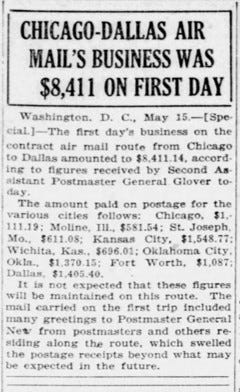
Yet, the story in Dallas told, not of the postal value, but of the financial contents of the cargo carried with a whopping $100,000 in cargo being received.

Dallas coverage also emphasized execution. The flights departed. The schedules held. The large initial volume of mail was accepted, processed, and carried forward. The tone was direct and confirmational. Dallas had taken its place as a southern terminal in an operating national system.
On this day, Dallas became the “Hub” and Fort Worth became the “Sub.” It’s a story from another day, but Fort Worth had bet that having 3 airfields would better position themselves to be the hub. Dallas had bet on just one airfield, Love Field. Dallas threw everything they had into the one airport in a make-or-break effort. It turned out that having a single stop per city was more desirable as it meant a simpler delivery system. It would be decades before the reality became clear and by that time, it was too late to change the trajectory.
By May 14, the results of those first two aircraft had reached New York, where the significance became unmistakable.
The New York Times reported that mail leaving Dallas at 7:00 a.m. on May 12 arrived in New York in just twenty-six hours, cutting more than a full day from the fastest rail service. Newspapers printed in Dallas that same morning were physically in New York reading rooms the following afternoon. The system did not promise speed, itt delivered it.
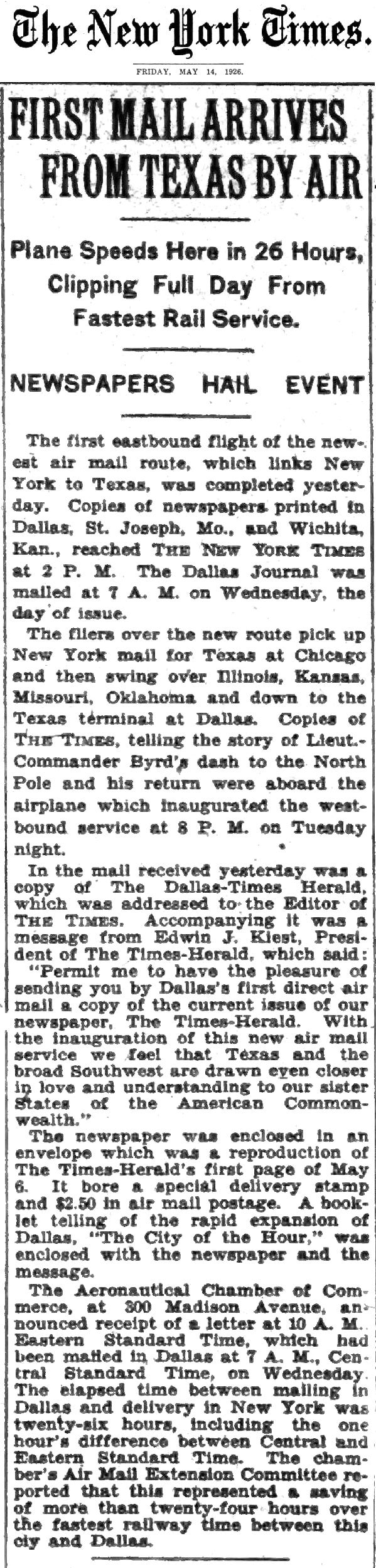
Within that same report, the message Dallas had prepared traveled alongside the mail itself. A Dallas newspaper sent eastward included a promotional booklet describing the city as “The City of the Hour.” The phrase did not remain within Texas. It arrived in New York at the exact moment the network proved its capability.
The message and the mechanism reached their destination together.
That convergence defines the importance of May 12, 1926.
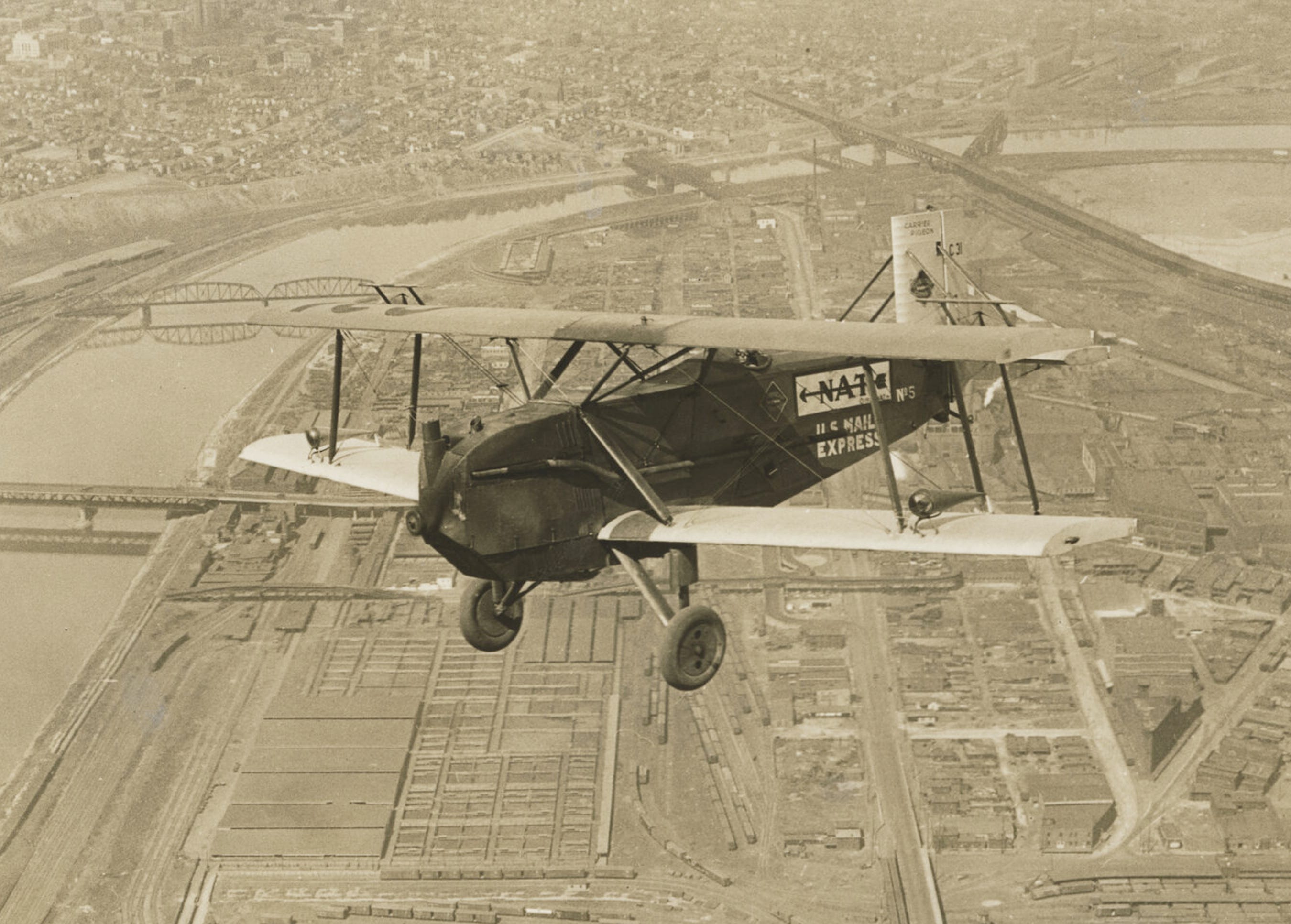
The aircraft that carried those first 20,000 to 25,000 letters were Curtiss Carrier Pigeon biplanes, operated by National Air Transport. These aircraft were not designed for spectacle. They were built for reliability, payload, and schedule discipline. Their significance lies in their ability to sustain a timetable, to move volume predictably, and to transform distance into schedule.
Dallas understood that immediately.
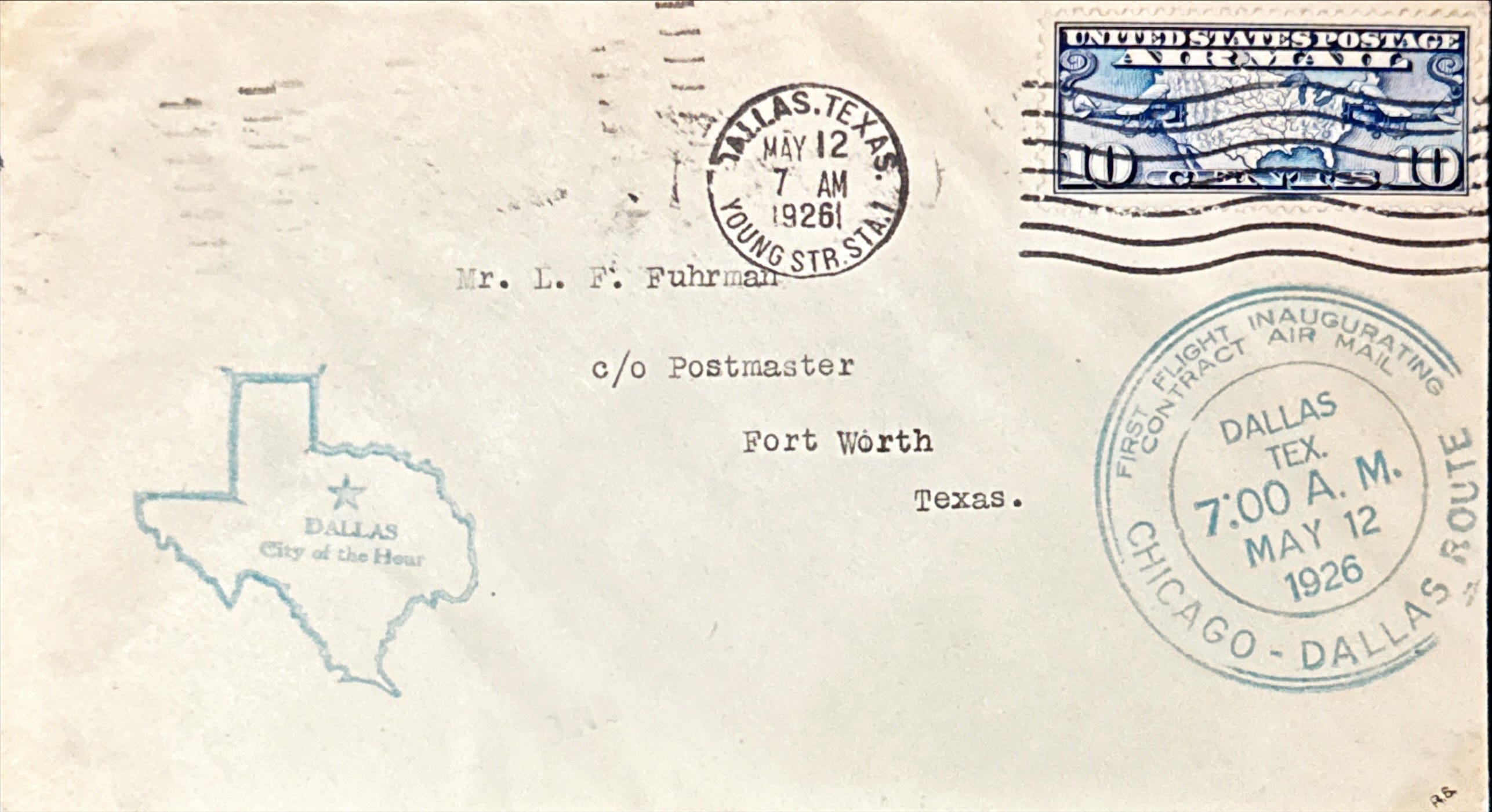
The surviving postal cover, displayed at the start of this article, was mailed at 7:00 a.m. that morning carries the full record of the moment. A timed Dallas postmark fixes the hour of entry into the system. A first-flight cachet marks the inauguration of CAM‑3. A civic marking identifying Dallas as the City of the Hour places the city’s identity directly onto the object moving through that network.
Each marking serves a function. Together, they form a statement.
The cover does not simply show participation. It shows intention. Dallas did not wait for recognition from outside. It placed its identity into circulation along with tens of thousands of letters and allowed the network to carry both outward at speed.
Chicago measured the revenue. Dallas recorded the operation. New York recorded the time.
This was not a local milestone observed later by others. It was a coordinated national event, visible simultaneously at the point of origin, across the route, and at the point of arrival.
The significance of that day lies in alignment. The volume of mail, the readiness of aircraft, the discipline of schedule, and the presence of national media attention all converged within a single operational window. The claim embedded in the phrase City of the Hour became measurable in letters carried, hours saved, and distance crossed.
Dallas was not forecasting its future. It was documenting its arrival.
In effect, it was a semaphore moment in time, Dallas signaling its presence across the nation in real time, carried in the mail itself.
The hour did not remain in Dallas.
It traveled.