


I have always believed that cities tell you who they are not only by what they build, but by what they choose together.
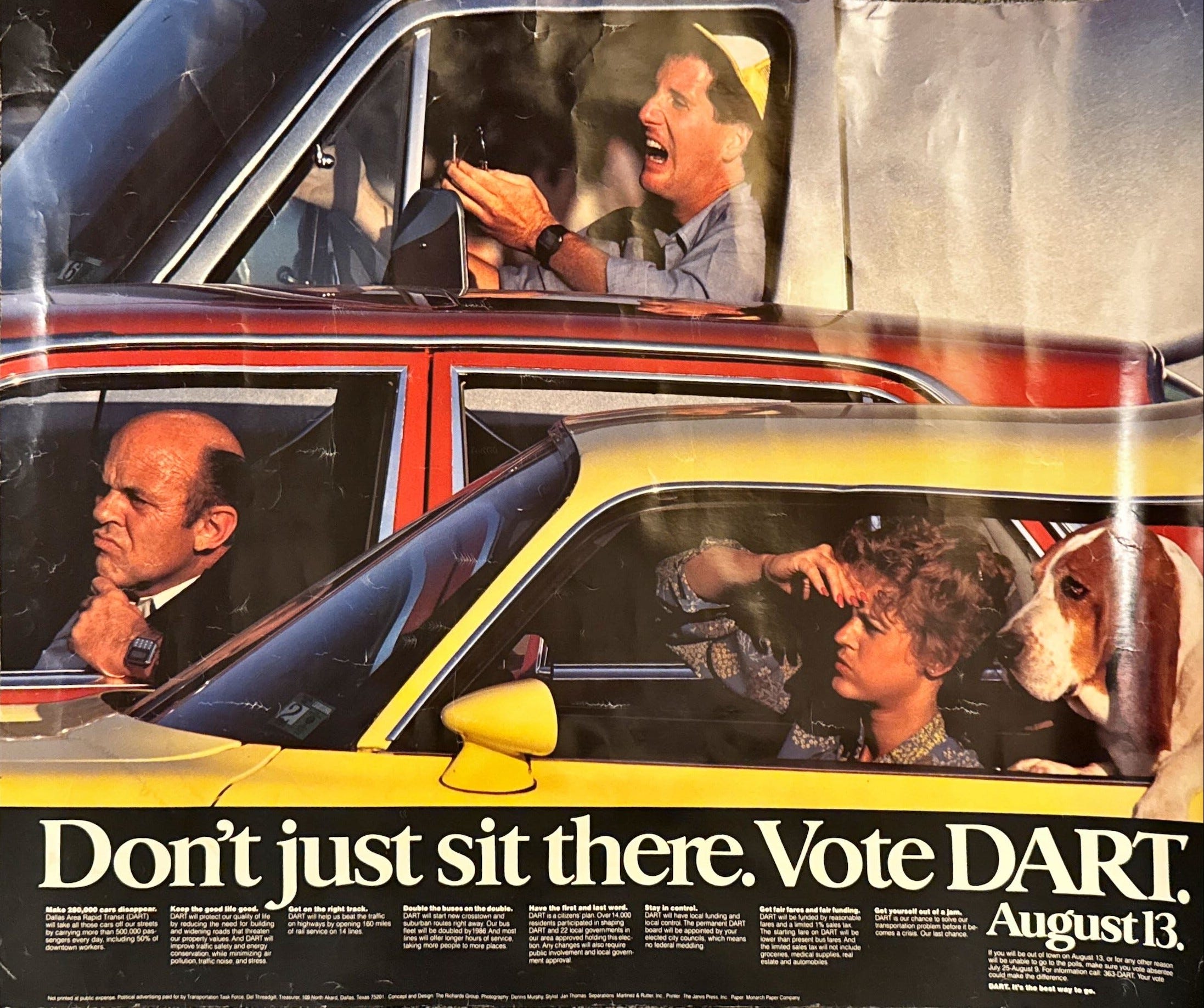
This poster comes from August 1983, a moment when North Texas stood at exactly that kind of crossroads. It reads simply, almost impatiently: “Don’t just sit there. Vote DART. August 13.” The image shows people trapped in their cars, stalled, surrounded by metal and motionless lanes. It does not explain policy. It does not promise comfort. It demands a decision.
That was the first election I was old enough to vote in.
I remember walking into the polling place with a sense of arrival that is hard to recreate once it has passed. Voting did not feel routine. How could it? It was my right of passage as I had finally become an adult (back then 18 was the Legal Age for everything). It literally gave me chills!
Marking a ballot for DART felt like stepping into the future of Dallas itself, not because the outcome was guaranteed, but because the choice required trust. Trust that growth could be guided. Trust that neighbors across city lines mattered. Trust that some problems were larger than any single municipality.
What voters approved that summer was not a transit system. There were no rail lines to admire, no stations to point to, no maps with reassuring timelines. What we voted for was the authority to imagine something bigger, the patience to build it, and the willingness to pay for a shared solution before the benefits were visible.
More than forty years later, the system that vote set in motion stretches across the region. Buses, rails, stations, park and rides. None of it arrived quickly. None of it arrived without argument. DART is not perfect, and it never has been. No institution shaped by decades of compromise can be. But it is real, and it exists because a generation of voters chose coordination over fragmentation.
The poster has not aged gently. I found it at an estate sale down the street from my home in December and instantly knew its purpose. I’ve held on to it so that I could share it with you now.
Its edges are worn, its surface creased, its colors softened by time. That wear feels honest. The same can be said of the system it helped bring into being. Both have been used. Both have absorbed criticism. Both have weathered changing expectations. Neither is pristine, and that is precisely the point.
Today, DART finds itself once again at a decision point. The language has changed. The debates now arrive wrapped in spreadsheets, ridership metrics, and fiscal return. Those tools matter. Accountability matters. But numbers alone cannot measure what is lost when regional cooperation begins to fracture.
In 1983, voters did not ask what they would personally get back the next year or even the next decade. They asked what kind of region they wanted to live in, and whether they were willing to invest together in something unfinished.
That question has not gone away.
Another vote is coming on May 2nd in Addison, University Park and Highland Park. The stakes are not abstract. They are civic. Infrastructure can be dismantled more easily than it is built, but the deeper risk lies elsewhere. When a region begins to turn inward, it forgets why shared systems exist at all.
I remain a passionate supporter of DART because I remember what it represented the first time we were asked to choose. Growth demands cooperation. Mobility is a regional promise. United we stand. Divided we fail.
Call to Action
That promise now rests, once again, with voters. On Saturday, May 2, 2026, residents of Addison, University Park, and Highland Park will decide whether their cities remain part of Dallas Area Rapid Transit.
Polls will be open from 7 a.m. to 7 p.m., with early voting already underway.
If you have friends and family in those cities, please call and encourage them to get to the polls, because the cost of doing nothing could cause the collapse of a system that is just starting to realize its promise we first established in 1983.
This is not a symbolic choice. It is a defining one. The decision made in these suburbs will echo far beyond their boundaries and shape whether North Texas continues to move as a region or fragments into smaller, isolated systems.