


In the early morning darkness of 1:14 a.m. on March 5, 2026, after more than sixteen grueling hours of debate, delay, frustration, and public outcry, the Dallas City Council cast a 9-6 vote that will be remembered as one of the most shameful civic decisions in the history of Dallas.
What began at 9:00 a.m. on March 4 as a special-called meeting to consider the future of City Hall ended in a decision that moved Dallas closer to abandoning its most iconic civic building and further from the will of its residents.
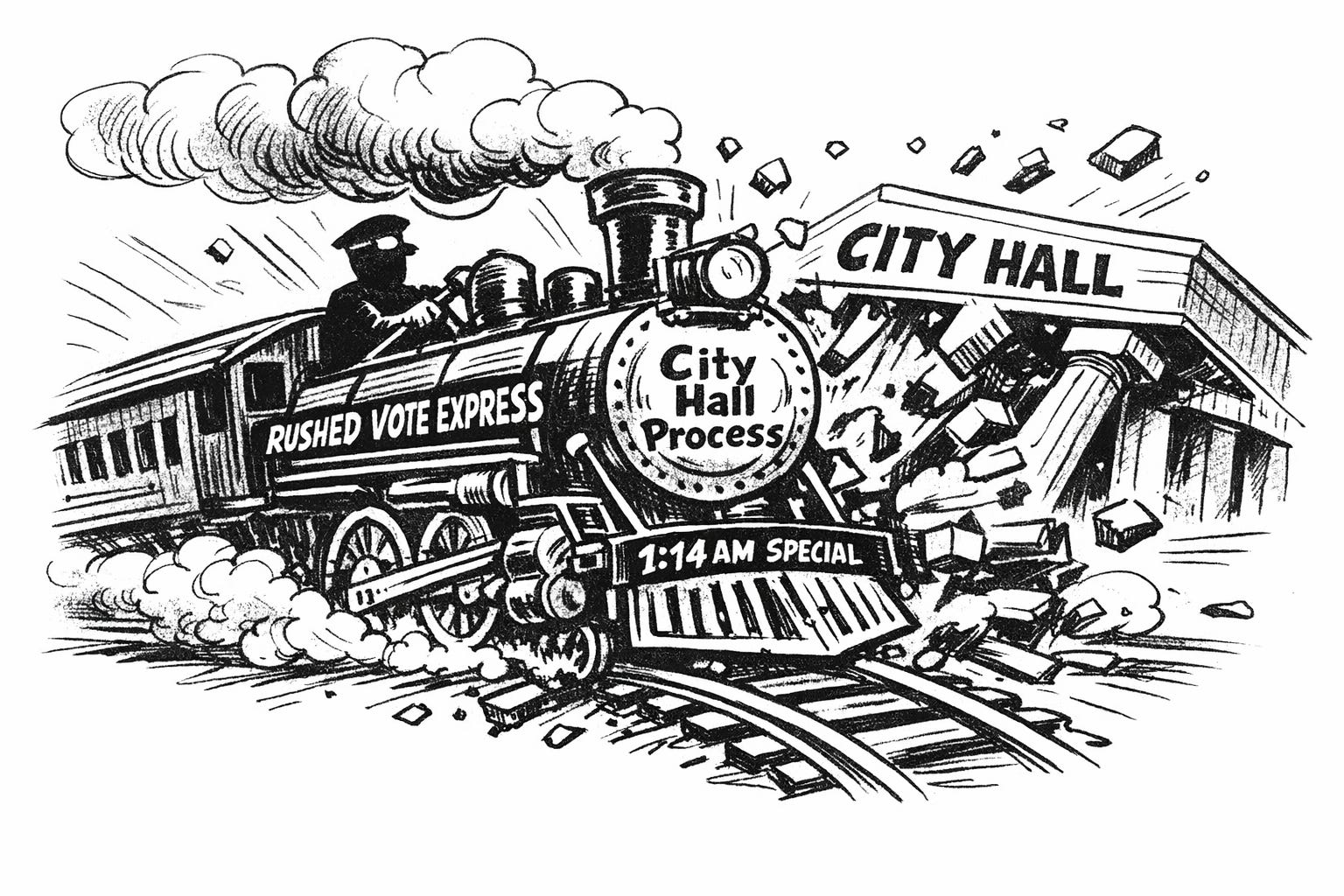
This was not governance.
This was treason in the extreme and the man leading the storm on City Hall was our most unpopular mayor Eric Johnson. He’s been railroading this decision through the council since the beginning. He doesn’t seem to understand that he should be working for all the people of Dallas and not just his billionaire friends.
But the most appalling thing to me was that my own council person Gay Donnell Willis supported this treason. Rest assured that she will never garner my vote again.
A Vote Forced Through Under Manufactured Urgency
The push for this vote did not arise from thoughtful deliberation. It was the product of an orchestrated, rapid-fire process initiated by Mayor Eric Johnson, who set the March 4 special meeting explicitly to force a vote on a resolution directing the City Manager to begin relocating core city operations and to explore redevelopment of the current City Hall site. [fox4news.com]
City staff were to be ordered to:
Move 311, 911, and emergency operations to new government facilities “as quickly as possible.” [fox4news.com]
Investigate relocation options for all remaining City Hall personnel.
Pursue redevelopment concepts, effectively placing the I.M. Pei‑designed landmark on a path toward displacement. [fox4news.com]
Residents recognized immediately what was happening. They filled the chamber days earlier, insisting the process was rushed, opaque, and misaligned with the city’s democratic obligations. Their frustration was not speculative; it emerged from the city’s own figures and timeline.
The Billion-Dollar Boogeyman
At the center of the push was a cost estimate claiming that keeping the current building operational for another twenty years would require $906 million to $1.4 billion in repairs and upgrades. [fox4news.com]
But that figure has been challenged repeatedly:
Preservationists and architects questioned the validity of the analysis, calling the report inadequate, misleading, and not independent. [dallasobserver.com]
Others noted that the estimate conflated urgent repairs with modernization enhancements and other optional upgrades.
Past assessments painted a dramatically different picture - including one estimating only $37–$39 million in required repairs. [newsbreak.com]
Still, nine Council members embraced the highest possible number without interrogating its assumptions. They allowed fear, not facts, to guide a decision of historic consequence.
The Most Personal Disappointment: Council Member Gay Donnell Willis
My greatest disappointment lies with Council Member Gay Donnell Willis.
In prior discussions, Willis publicly emphasized that City Hall would always remain a welcoming civic space with an open plaza, regardless of its location. It was a reassuring sentiment from a representative entrusted with protecting the public’s access to its own government. [nbcdfw.com]
Yet when the defining moment arrived in the pre-dawn hours of March 5, she voted in favor of the resolution - a vote that, by its very nature, accelerates the displacement of civic life from the building that has symbolized Dallas’ democratic identity for nearly fifty years.
She did not slow the process.
She did not question the timeline.
She did not defend the building or the people who spoke passionately in its defense.
She did not listen to the 90% plus of her constituents that told her to “Save City Hall!”
She did not stand up for what was right.
The disappointment is justified.
A Decision Taken After the Public Could No Longer Watch
If the proposal itself was troubling, the timing of the vote was worse.
By pushing deliberations deep into the night and ultimately into the next day, the Council guaranteed that only the most dedicated observers could follow the proceedings. The vast majority of residents, including those who had taken time to show up and speak earlier in the week, had no realistic ability to witness the conclusion. Fortunately, I’m a night owl.
A democracy cannot function when the most consequential decisions are finalized after midnight, under exhaustion and diminishing public visibility.
What Dallas Stands to Lose
This vote is more than a question of HVAC systems and leaking roofs. What is at stake is:
A civic landmark: One of the most distinctive buildings in Dallas, designed by I.M. Pei and featured prominently in the city’s cultural history. [newsbreak.com]
A public asset already paid for: A building that belongs to the people, not to developers or speculators. [fox4news.com]
Democratic space itself: The chambers, plaza, and public areas that define how Dallas sees itself, assembles, and participates in its own governance.
Continuity and identity: Once City Hall is moved, the symbolic and practical center of Dallas fractures.
Opponents of the proposal made this clear when they spoke during earlier hearings, with residents calling the process “corruption,” “insulting,” and a profound betrayal of public trust. [fox4news.com]
The Fight Is Not Over
Although the 9–6 vote moves Dallas closer to abandoning the current City Hall, it is not final. There remain pathways for preservation:
The Landmark Designation Committee has already begun exploring a historic designation, a move that could complicate efforts to demolish or radically alter the structure. [newsbreak.com]
Further public pressure can demand transparent, phased repair assessments rather than the all-or-nothing framing presented thus far.
Civic organizations, architects, and residents can organize to challenge the redevelopment narrative and defend the building “paid for by the people for the people.”
The story of Dallas City Hall is not finished.
But the events of March 4–5 will remain a stain on the city’s reputation.
Conclusion: A Breach of Trust That Will Not Be Forgotten
The early-morning vote was not responsible leadership.
It was a rushed and reckless breach of the public trust, carried out after an exhausting sixteen-hour session that left little room for accountability.
Dallas deserves better.
Dallas deserves transparency.
Dallas deserves representatives who are willing to stand firm in the face of political pressure and procedural manipulation.
And Dallas will remember who stood for the people -
and who stood against them.
Any building by I M Pei is a national treasure.